

What a custom backyard costs in Kelowna, and how to read a quote
Two quotes for what looks like the same pool can land tens of thousands apart. Almost always, the gap is not greed. It is scope. Here is how to find it.
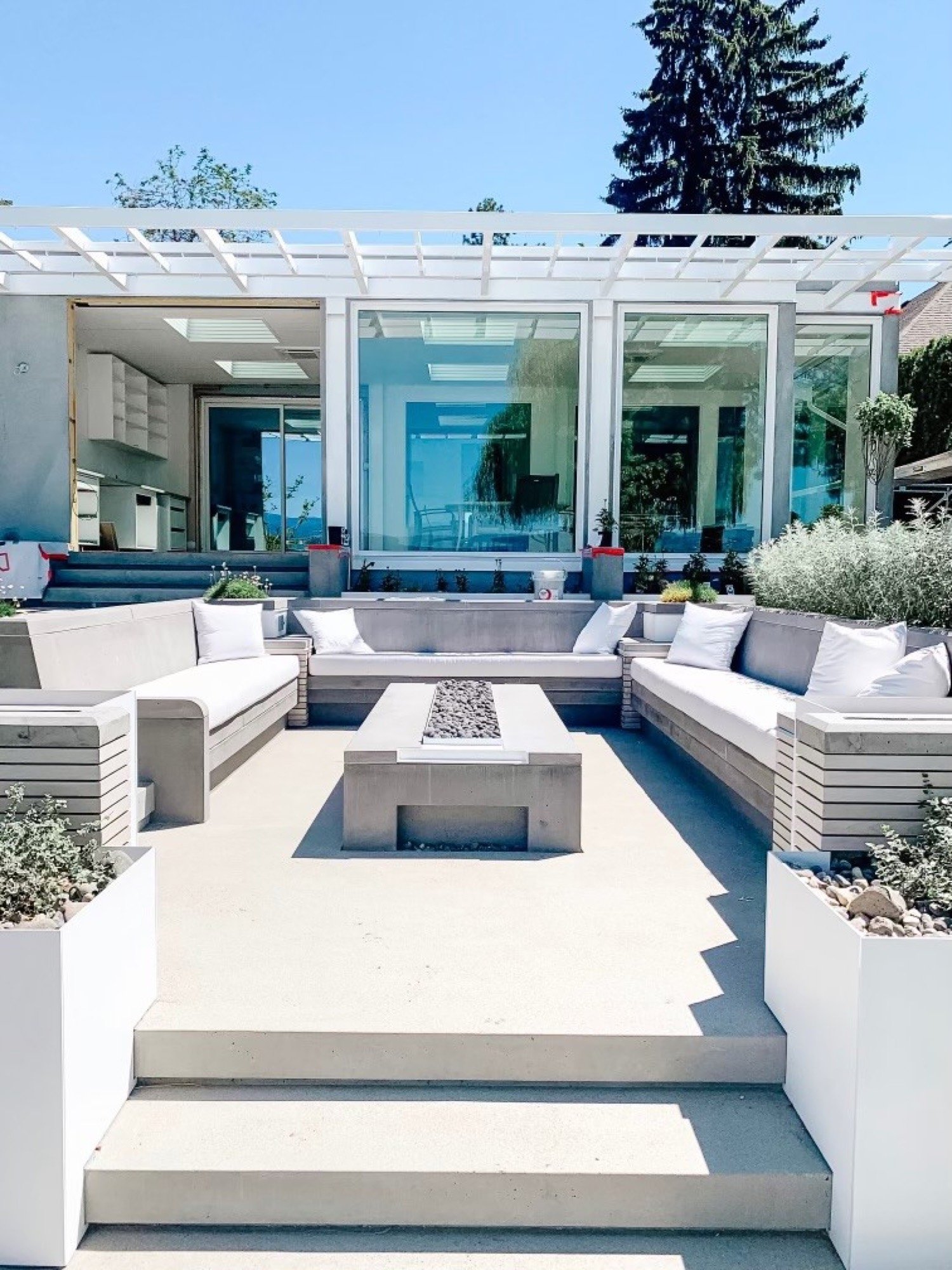
Every spring we get the same phone call. Someone has three quotes on the kitchen table for a pool in their Kelowna backyard. The low one is $95,000. The high one is $160,000. They want to know which contractor is trying to take them for a ride.
Usually neither. What has happened is that three builders have priced three different projects and all three called it a pool. One included the patio around it and one did not. One allowed for a retaining wall that the grade is going to demand and the others left it as a problem for later. One priced a real deck and one wrote the word "decking" beside an allowance number that was never going to hold.
You cannot compare quotes until you can see the scope inside them. This guide is how we walk homeowners through that, written the way we would explain it standing in your yard.
The three budgets inside every backyard
It helps to stop thinking of a backyard as one number and start thinking of it as three. Almost every project we build in the Okanagan splits along these lines, and most quote confusion comes from a line moving between them or falling out entirely.
| Budget | What sits inside it | What gets forgotten |
|---|---|---|
| The hole | Excavation, spoil removal, engineering, steel, shotcrete or formed shell, plumbing, equipment pad, filtration, interior finish, coping, water. | Rock. Access. Where the dirt goes. |
| The ground | Base prep, drainage, compaction, rebar, patio pours, walkways, steps, retaining walls, grading back to the house. | Drainage. Always drainage. |
| The structures | Decks, stairs, pergolas, awnings, privacy screens, outdoor kitchens, pool houses, saunas, fencing and gates. | The finishing carpentry that makes it look built rather than assembled. |
A quote that covers all three is going to be a bigger number than a quote that covers one. That does not make it worse value. It makes it the only one that tells you what the finished yard costs.
The carpentry line is the one people underestimate
Nobody is surprised that a pool shell is expensive. What surprises people is the carpentry. A deck, a pergola and a set of stairs sound like a weekend compared to excavating a hole and pouring a concrete shell, and then the number comes back at $40,000 and the whole conversation stops.
The reason is that carpentry is labour, not material. The lumber on a pergola is a small fraction of what it costs to build one properly. The rest is layout, cutting, fitting, scribing to surfaces that are never perfectly square, and finishing.
The carpentry trade in general splits work into categories worth knowing, because a good quote will use them. iDesign Interior Solutions, a Maryland contractor that has been doing millwork for more than twenty-five years, breaks their carpentry into custom built-ins, decorative molding, finish carpentry and staircase work, and describes a four-stage process that matches how we work outdoors: measure and design to the actual space, build the pieces, install and scribe them on site, then finish. It is the third stage that separates carpentry that looks custom from carpentry that looks bought.
Their published 2026 ranges are a useful reality check even though they are in US dollars and indoors. They list trim and molding at roughly $1,500 to $6,000 per room, custom built-ins at $2,500 to $8,000, and staircases from $5,000 past $20,000. Outdoor work in the Okanagan carries different numbers because it fights weather, freeze and thaw, and UV, but the shape of the pricing is identical. Labour and detail drive it, not the wood.
What to look for on the carpentry line
If a quote says "deck and pergola, $38,000" and stops, you do not have a quote. You have a number. Ask for the species and grade of lumber, the fastening system, the footing detail, the railing, the finish, and whether staining or sealing is included or something you are expected to organize yourself in the fall.
What is actually inside a contractor's price
Here is a part most homeowners never get told, and it explains a lot about why quotes differ.
Every contractor's price carries the cost of finding you. Trucks, insurance, warranty reserve, office time, and the cost of getting the phone to ring in the first place. That last one is bigger than people assume and varies enormously between companies.
Concrete Marketing publishes Canadian benchmarks for what it costs contractors to win a residential job, and the spread is wide. Their figures put acquisition at roughly $133 per signed concrete repair, $441 per driveway replacement, $714 per stamped patio and $1,182 per foundation job. By channel, they put Google Search Ads near $483 per signed job and Meta near $550, against referral and organic work which costs nothing to acquire.
They also publish a ceiling that we think every homeowner should know: take the average job value, multiply by gross margin, and take twenty percent of that as the most a contractor can sanely spend to win the work. On a $6,000 job at thirty percent margin, that is about $360.
A contractor paying well above that ceiling has to recover it somewhere. It comes out of the quote, or it comes out of the build.
This is not an argument that advertising is bad. It is an argument for understanding why a referral-driven builder and a lead-platform-driven builder can quote the same yard differently, and why the cheapest quote in the pile sometimes belongs to the company that needs volume to cover what it spends chasing volume.
Ask any contractor where most of their work comes from. If the answer is past clients and other trades, that is a real signal about both their overhead and their finished product.
Timing is the biggest lever you control
If you want one practical thing out of this article, make it this one.
The same benchmark data shows what everyone in the trades already knows from the inside: demand is violently seasonal. Contractor acquisition costs run twenty to forty percent higher from March through May, normalize over the summer, and hit their best value window in September and October before bottoming out through winter.
Translated into your kitchen table, that means:
- Calling in April puts you at the back of a line. Every good crew in the valley is booked, quoting is rushed, and you are competing for attention.
- Calling in September or October buys you the two things that make projects go well: design time and permitting time, both of which are free if you have them and expensive if you do not.
- Winter is not dead time for a builder. It is when drawings get done, engineering gets stamped, permits get pulled and materials get ordered, so the dig can start the moment the ground allows.
This is why we tell people that a pool booked in the fall is a pool you swim in the following summer, and a pool booked in May is usually a pool you swim in the summer after that.
Ten questions to ask before you sign anything
Take these to every quote you have, including ours. The answers will sort the pile faster than the numbers will.
- Is this a fixed price or an allowance? Find every allowance line and ask what happens when it is exceeded.
- Who pulls the permits, and is that cost in here? In Kelowna, pool enclosure and fencing requirements are not optional.
- Is the engineering included and stamped? Ask specifically about retaining walls and anything on a slope.
- What is the concrete spec? Strength, air entrainment, rebar schedule and joint layout should be written down, not assumed.
- What is the drainage plan? Where does water go in a March thaw, and where does it go in a July downpour.
- What happens if you hit rock? Excavation surprises are the single most common change order in this valley.
- Where does the spoil go? Hauling material off a site is a real cost and it is often quietly excluded.
- Who is actually on site? Your crew, or four subcontractors coordinated by text message.
- What is the change-order process? It should be written, priced and signed before work happens, never after.
- What is the warranty, in writing, and who honours it? A warranty from a company that will not be here in five years is a piece of paper.
One more, and it is the important one
Ask to stand in a backyard they finished three or four years ago. Not last month. Anything looks good the week the site gets cleaned up. What you want to see is what the concrete, the coping and the carpentry look like after a few Okanagan winters have had a go at them.
How we quote it
We come out, walk the yard, look at the grade, the access and where the water goes, and talk about how the family will actually use the space. Then you get a plan and a quote that separates the pool, the concrete and the carpentry so you can see all three budgets and decide what happens now and what happens in phase two.
Because the pool, the hardscaping and the carpentry are all ours, nothing falls into a gap between contractors, and there is nobody to point at when something needs sorting out. That is the whole reason we do all three.
Site visits and quotes are free, and there is no obligation on the other side of one. If you are thinking about next summer, now is the right time to be having the conversation.
Sources and further reading
- Concrete Marketing, "What Concrete Jobs Cost to Win: Cost Per Lead and Cost Per Job Benchmarks". Canadian residential acquisition-cost benchmarks by service type and channel, the twenty percent of gross profit spending ceiling, and the seasonal demand curve referenced above.
- iDesign Interior Solutions, "Custom Carpentry Services in Bethesda and Rockville". Carpentry categories, the measure, build, install and finish process, and published 2026 millwork price ranges.
Figures quoted from third parties are theirs, not ours, and are included as reference points rather than Okanagan pricing. Your number comes from a site visit.